

Mexty Launches an AI-Native Learning Infrastructure to Help Enterprises Design and Deploy Interactive Training
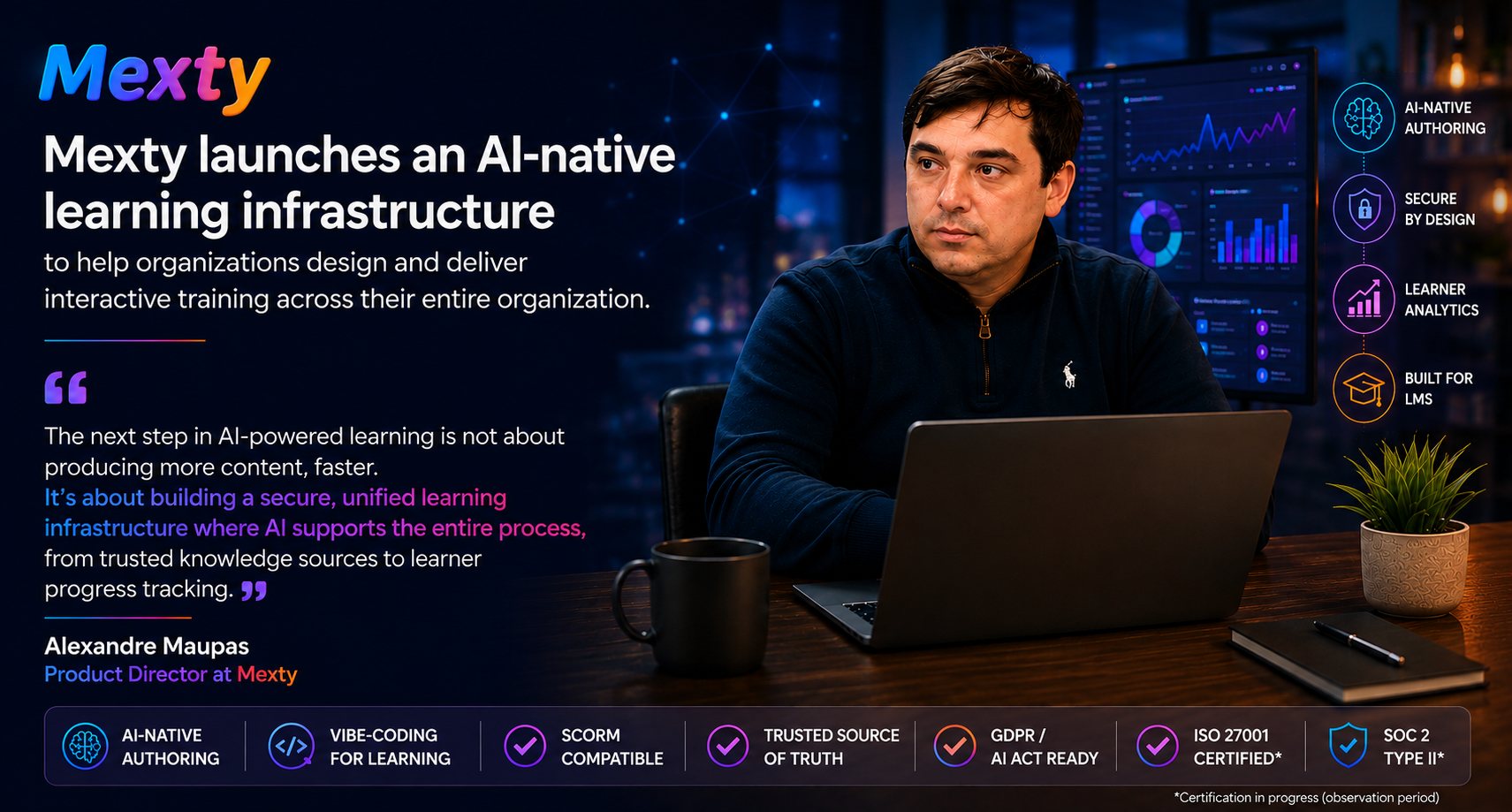
Mexty Launches an AI-Native Learning Infrastructure to Help Enterprises Design and Deploy Interactive Training Across Their Organizations
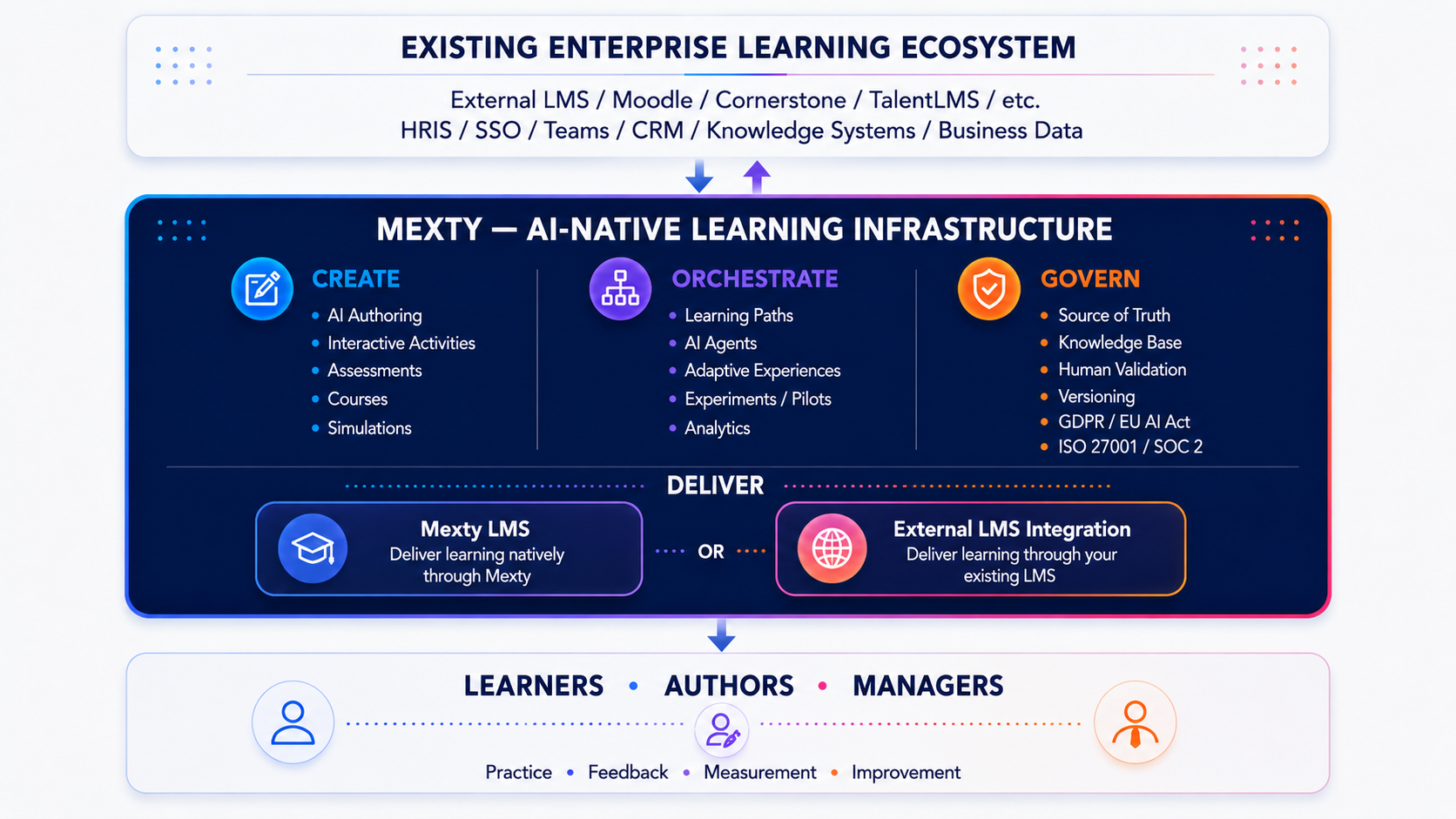
Mexty Infrastructure
logo
A secure, unified AI-native infrastructure connecting trusted knowledge, interactive learning, human validation, learner support and analytics.
Mexty was designed to meet this need.
The next stage of AI in learning is not simply about producing more content, faster. It is about establishing a secure and unified learning infrastructure in which AI supports the entire process, from knowledge sources through to tracking learner progress.”
From Content Creation to a True Learning Infrastructure
Mexty enables enterprises to transform their existing resources, such as PDF files, internal policies, employee onboarding documents, product guides, procedures, or training presentations, into interactive learning experiences.
The platform enables organizations to design interactive courses, learning paths, scenario-based activities, assessments, role-specific onboarding journeys, AI assistants to support learners, LMS-ready content, as well as dashboards for tracking and analyzing results.
Unlike traditional training creation processes, which often rely on several disconnected tools, Mexty brings content creation, delivery, learner support, and results analysis together in a single environment designed from the ground up around artificial intelligence. Learning and development teams, instructional designers, trainers, operational managers, and subject-matter experts can therefore collaborate from the same validated knowledge base while retaining human control over the learning experience ultimately delivered to learners.
A Multi-LLM Architecture Designed for MCP Compatibility
Mexty takes a multi-LLM approach and supports several leading artificial intelligence models, including ChatGPT, Claude, Gemini, and Mistral. Enterprises can therefore choose the model best suited to each learning task without depending on a single model or provider.
The platform is also designed to be compatible with the Model Context Protocol (MCP), a standard that enables complementary artificial intelligence services and enterprise tools to connect to the same learning infrastructure. With a single subscription covering the infrastructure and associated services, Mexty helps organizations simplify deployment, avoid the proliferation of separate tools, and reduce the overall cost of their investments in AI for learning.
Mexty is also designed to meet demanding enterprise requirements for governance, security, and compliance. The platform complies with the General Data Protection Regulation (GDPR) and the European Union Artificial Intelligence Act (“EU AI Act”), and it is ISO 27001 certified. The controls required for SOC 2 Type II are fully implemented, and the attestation process is now in the required observation period.
Designed to Meet Enterprise Learning Needs
Mexty’s AI-native learning infrastructure is designed for organizations seeking to deploy learning at scale across the enterprise while maintaining the expected levels of control, security, and quality.
Key enterprise use cases include employee onboarding and training, compliance and internal policy training, cybersecurity awareness, sales enablement, customer service training, product and internal process training, foundational AI literacy, responsible AI awareness, and management skills development.
For example, an enterprise can use Mexty to transform its onboarding documents into a complete and interactive learning journey. Instead of asking new employees to review PDF files or static presentations, it can provide guided modules, realistic scenarios, step-by-step tool demonstrations, security decision-making simulations, assessments, and an AI assistant grounded in internal sources validated by the organization.
Learners can practice through realistic situations, ask questions, receive feedback, and progress through a structured learning path. Learning and development teams, together with operational managers, can then track progress, identify areas of difficulty, and improve the journey based on concrete data.
Human Control at the Heart of the System
Mexty’s approach is based on a simple principle: AI should support learning teams, not replace them.
The platform helps teams accelerate training creation while preserving human review, manual editing, validation, governance, and instructional judgment.
“AI can help generate, structure, rephrase, adapt, and guide,” adds Alexandre Maupas. “But the quality of a learning experience still depends on human expertise: understanding the target audience, defining the right objectives, selecting relevant practice activities, validating content, and ensuring that the training genuinely helps employees perform their jobs better.”
An Index for Measuring Learning Infrastructure Maturity
As part of this positioning, Mexty is introducing its AI-Native Learning Infrastructure Maturity Index, a framework designed to help organizations understand where they stand in their adoption journey for AI in learning.
The index defines six levels: Level 0 – No AI, Level 1 – AI Experimentation, Level 2 – AI Content Generation, Level 3 – AI-Assisted Learning Processes, Level 4 – AI-Integrated Learning Environment, and Level 5 – AI-Native Learning Infrastructure.
The index encourages enterprises to move beyond the simple question, “Are we using artificial intelligence?” and ask a more strategic one: “Is AI genuinely improving how we design and deliver learning, support learners, measure results, and govern the learning process?”
A New Foundation for Enterprise Learning
Mexty believes that the next generation of learning platforms will not be defined solely by faster or more automated content creation. It will be defined by the ability to connect every stage of the learning cycle.
This means helping organizations move from static content to active learning, from isolated courses to structured learning journeys, from generic AI-generated answers to creation grounded in trusted sources, and from simply tracking course completion to concrete indicators of learner progress.
“Enterprise learning needs a new foundation,” says Alexandre Maupas. “The future is not limited to content created with the help of artificial intelligence. It is built on a learning infrastructure designed from the ground up around AI.”
About Mexty
Mexty is an AI-native learning platform that helps organizations create, deploy, and track secure, interactive learning experiences from trusted knowledge sources. It combines AI-assisted authoring, interactive activities, learning paths, assessments, learner support, and analytics in one environment designed for enterprise learning.
Marva OKILI
Mext
+33 665919991
email us here
Visit us on social media:
LinkedIn
Instagram
Facebook
YouTube
X
Enterprise Learning Needs More Than AI
Legal Disclaimer:
EIN Presswire provides this news content "as is" without warranty of any kind. We do not accept any responsibility or liability for the accuracy, content, images, videos, licenses, completeness, legality, or reliability of the information contained in this article. If you have any complaints or copyright issues related to this article, kindly contact the author above.
