

8 Payroll Process Steps Every Indian Employer Must Follow | TankhaPay
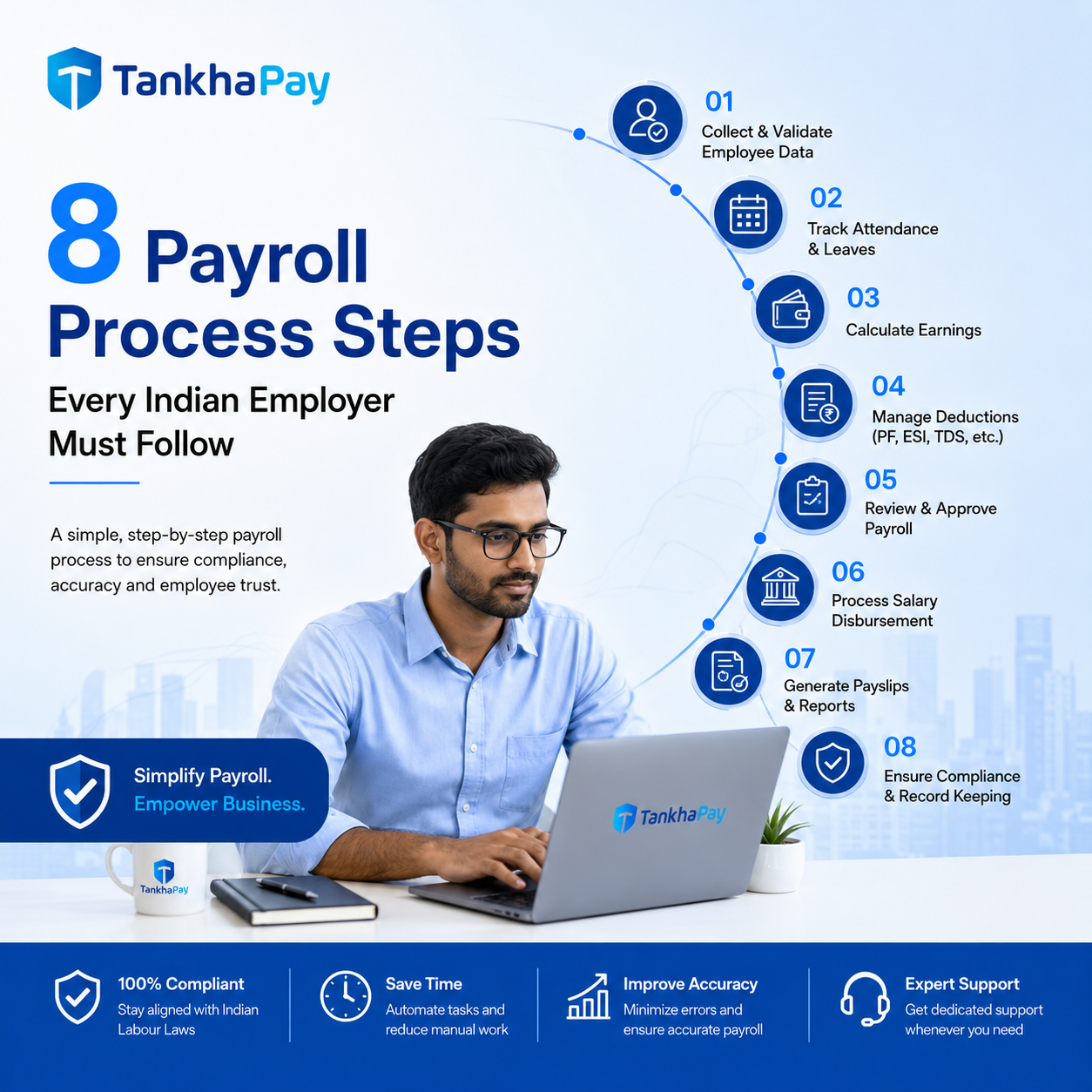
8 Payroll Process Steps Every Indian Employer Must Follow

payroll process steps for FY 2026–27 — covering Labour Codes, Income Tax Act 2025, TDS changes, and statutory filing deadlines.
TankhaPay, India's leading payroll and HR compliance platform operated by Akal Information Systems Ltd, today published a comprehensive guide outlining the eight essential payroll process steps Indian employers must follow in FY 2026–27. The release comes as Indian businesses navigate their most complex compliance year in decades, with the Income Tax Act 2025 replacing the 1961 Act from April 1, 2026, and all four national Labour Codes now in full effect following their November 2025 activation.
"Running payroll in India has always required precision," said a TankhaPay spokesperson. "In 2026, the margin for error has shrunk further. New TDS section numbers, revised form names, updated contribution rules under the Labour Codes — a payroll system that was compliant in March 2026 may not be compliant today. Every employer needs a structured process they can run consistently every month."
TankhaPay, trusted by 1,000+ client organisation across India, outlines the following eight-step payroll process for Indian employers in FY 2026–27:
1. Collect and Verify Employee Data
Every payroll cycle begins before a single calculation is made. HR teams must verify active headcount, confirm joining and exit dates, validate bank account details, collect investment declarations under the new Income Tax Act 2025 regime, and update any mid-month salary revisions. Errors at this stage compound through every downstream step.
2. Track Attendance and Leave Accurately
Accurate recording of hours worked, including overtime, paid leaves, and holidays, is vital for fair compensation and compliance with Indian labour laws. Payroll inputs — particularly for blue-collar and shift-based workforces — must pull from verified attendance data, not manual estimates. TankhaPay's attendance system uses geofencing, facial recognition, and GPS tracking, feeding directly into payroll without manual intervention.
3. Calculate Gross Pay
Gross pay includes the employee's total earnings: basic salary, allowances, bonuses, and any other income components. Under the Code on Wages 2019, basic salary inclusive of Dearness Allowance must now be at least 50% of total CTC — a rule that restructures gross pay calculations for employers who historically ran high-allowance, low-basic salary structures.
4. Apply Statutory Deductions
This is the highest-risk step in the payroll process. Four deductions must be calculated accurately every cycle:
PF: 12% of basic salary deducted from employee; 12% contributed by employer under EPF Act 1952
ESI: 0.75% employee contribution; 3.25% employer contribution for employees earning ≤ ₹21,000/month
TDS: Calculated under Section 192 of the Income Tax Act — now governed by the Income Tax Act 2025 for all salary payments from April 2026 onwards. Old section references on filings will trigger validation errors
Professional Tax: State-specific slab-based deduction — varies across Maharashtra, Karnataka, West Bengal, Telangana, and other applicable states
Missing any one statutory obligation creates a liability that compounds quietly every month.
5. Calculate Net Pay
Net pay is gross pay minus all statutory deductions, voluntary deductions (loans, advances), and any applicable Labour Welfare Fund contributions. The final figure must be validated against the applicable state minimum wage — paying below minimum wage, even unintentionally, is a statutory violation under the Minimum Wages Act 1948.
6. Disburse Salaries on Time
Timely processing of salary payments via direct deposit or bank transfer is vital for ensuring employee satisfaction and retention. Under the Payment of Wages Act, salary must be paid by the 7th of the following month for organisations with fewer than 1,000 employees, and by the 10th for larger organisations. Late disbursement triggers employee grievances and statutory liability simultaneously.
7. File Statutory Returns and Deposit Contributions
Every payroll cycle generates filing obligations with hard deadlines:
PF contributions: Deposit by the 15th of the following month; ECR filing by the same date
ESI contributions: Deposit by the 15th of the following month
TDS deposit: By the 7th of the following month
Form 24Q: Quarterly TDS return filed under the Income Tax Act 2025 — form names and section references have changed from the 1961 Act; payroll systems must reflect updated formats before filing
Professional Tax: Monthly or annual payment per state schedule
Compliance requires timely monthly tax payments, filing Form 24Q quarterly, issuing Form 16 annually, and maintaining accurate payroll records.
8. Maintain Payroll Records and Issue Payslips
Employers must maintain digitised payroll records covering wages, attendance, statutory deductions, and compliance registers. A structured checklist helps confirm that compliance tasks are completed at each stage of payroll processing. Payslips must be issued to every employee within 24 hours of salary disbursement. Form 16 must be issued to all employees annually — the deadline for FY 2025–26 is June 15, 2026.
Hemant
Akal Information system Ltd.
+91 98919 88811
seo@tankhapay.com
Visit us on social media:
LinkedIn
Instagram
Facebook
YouTube
X
Hassle Free Payrolling and TF/ESI Complainces for Your Business
Legal Disclaimer:
EIN Presswire provides this news content "as is" without warranty of any kind. We do not accept any responsibility or liability for the accuracy, content, images, videos, licenses, completeness, legality, or reliability of the information contained in this article. If you have any complaints or copyright issues related to this article, kindly contact the author above.
